By RWI Watches editorial team. Reviewed September 11, 2026.
QC photos help you compare the proposed watch with your written order and identify visible concerns before approval. They cannot certify its factory, metal composition, water resistance or long-term reliability. A useful review ends with a record of what you can see, what the seller has stated and what remains unverified.
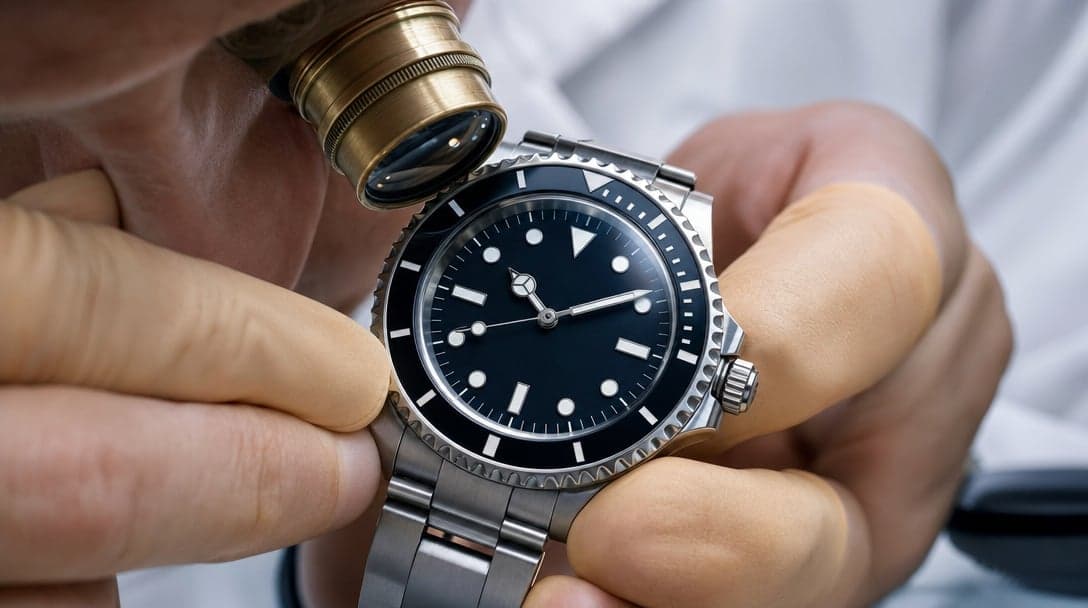
RWI Watches at rwi.us.com is commercially operated and shares ownership with some sellers it covers. It is a separate website from the Replica Watch Info forum. This guide describes a review method, not an independent certification of a watch or seller. The header image is an editorial illustration, not an inspected customer watch.
Start with the exact order
Save the product URL and the configuration agreed with the seller: model, stated reference, case size, dial, bezel, bracelet and offered movement. Ask whether the photos show the specific unit proposed for your order. A catalogue photograph or an old customer album is not evidence of that unit's condition.
Request an identifiable photo set with the date or order reference, while keeping personal information out of anything you share publicly. Record the seller's answer if the images cannot be tied to the proposed unit. Do not assume that a watermark alone establishes provenance.
The 12 checks
1. Match the configuration
Compare the visible dial, bezel, bracelet and date display with your saved order. A similar product name can cover several configurations. For dimensions and hidden components, record the written specification separately from what the photographs show. Resolve any mismatch before giving approval.
2. Check whether the photographs are usable
Ask for a straight-on dial photograph, both case sides, the case back, clasp and bracelet connections. Request another view where reflections or protective film obscure the surface. Camera angle and lens distortion can affect apparent alignment, so an overlay on a tilted photograph is a reason to request a clearer image, not a precise measurement of a defect.
3. Inspect dial printing and markers
Look for legible printing, visible damage and markers that appear inconsistent with the agreed configuration. Compare a straight-on view with an angled view before deciding that a marker is displaced. Do not assign a millimetre tolerance from an uncalibrated image or assume every model uses the same type of markers.
4. Review hand position and demonstrated functions
If hand alignment concerns you, request a photograph at a clearly stated time and a short video showing the relevant function. A still image cannot demonstrate the operation of a date mechanism, GMT adjustment or chronograph. Ask the seller to demonstrate the supplied movement's functions using the appropriate instructions.
5. Examine the date window and magnifier
Where fitted, check whether the date is readable and appears centred in a straight-on view. Request additional dates if a specific numeral looks misplaced. Photograph distance, angle and cropping change apparent magnification. An ordinary QC photograph does not establish an exact magnification ratio.
6. Inspect the bezel and visible insert
Look for visible chips, uneven markings and the alignment of the insert in an appropriate view. A photograph may show a cosmetic concern, but it does not confirm ceramic composition or the metal used in an engraving's infill. For a rotating bezel, request a demonstration if its operation matters to your purchase.
7. Check case surfaces and bracelet connections
Request both side profiles and close views of the bracelet connections. Mark apparent scratches, gaps or uneven finishing and ask for a view without the reflection or protective film that may obscure them. Photographs do not establish how edges feel against your skin or how the bracelet wears over a full day.
8. Review the clasp and fit information
Ask the seller to demonstrate opening and closing the clasp and to confirm the included links and adjustment options. Compare those details with your wrist measurement. A clasp photograph cannot establish long-term holding strength, and a bracelet's visual resemblance does not establish its material grade.
9. Treat material and factory names as claims
Record the exact factory, movement and material descriptions the seller supplies, together with the date and source. Neither polished appearance nor the watch's overall weight proves a steel grade. Factory stickers and packaging also require provenance. Leave a specification labelled as seller-reported when independent evidence is unavailable.
10. Separate movement appearance from identification
A clear movement photograph may reveal visible features or an obvious inconsistency with the advertised description. Decoration can obscure the underlying construction, and a photograph is not a complete mechanical inspection. Ask what evidence supports the supplied movement designation. Case opening and physical inspection belong with a competent watchmaker when needed and agreed with the seller.
11. Put timing evidence in context
If timing results are supplied, ask for the tested unit, date, watch position, winding state and device settings. Rate, amplitude and beat error are different measurements. A single display describes a test under particular conditions; it does not promise the same daily result on your wrist or prove long-term reliability. Avoid universal pass/fail numbers detached from the movement's specification and test conditions. Witschi's measurement documentation identifies these as separate test outputs.
12. Keep lume and water resistance separate
A lume photograph can help compare visible illumination under the conditions used. It does not establish the luminous compound or how long the glow lasts. A case-back marking, crown photograph or seller demonstration is not a pressure-test report. Ask for unit-specific test evidence if water resistance is material to your decision; do not use immersion as an informal QC test.
Record observations before making a decision
Use one row per concern so replies stay attached to the relevant evidence.
| Field | What to save |
|---|---|
| Item | The agreed configuration or function being checked |
| Evidence | Image filename, video timestamp or written reply, with date |
| Observation | What is actually visible or stated |
| Limitation | What the evidence does not establish |
| Next action | Clarification requested, replacement set requested or approval recorded |
A fictional example: the date appears off-centre in an angled image. Record the filename and ask for a straight-on photograph of that date. Until it arrives, record the item as unresolved. Do not turn uncertainty into either a defect verdict or an approval.
Questions to send before approval
- Do these images show the specific unit proposed for my order, and how is it identified?
- Does it match the configuration we agreed in writing? Please confirm any change.
- Please provide a clearer view of these specific concerns: [list image names and observations].
- Which requested specifications are seller statements, and which have unit-specific test evidence?
- What happens if I request another unit, cancel before dispatch or report an issue after delivery?
- Please confirm the applicable time limits, exclusions and responsibility for return shipping in writing.
The terms behind those last two questions have their own field lists in our guide to seller terms.
Keep your approval linked to the exact photo set and final configuration. If either changes, obtain the new evidence before approving that change. Read the actual seller's terms instead of assuming that a label such as "trusted dealer" creates a universal refund or warranty policy.
Frequently asked questions
Can QC photos establish that the delivered watch will be the same unit?
They can form part of a record when the seller identifies the proposed unit. They do not guarantee the identity or condition of a later delivery. Retain the order, photo set, replies and dispatch evidence, then document the delivered item and any discrepancy promptly.
Can I verify the movement or steel grade from the photos?
Photos may reveal visible inconsistencies worth investigating. They do not provide a complete movement inspection or material analysis. Keep the seller's description labelled as a claim unless suitable evidence supports a stronger conclusion.
How long should the review take?
There is no reliable thirty-second rule. Work through the evidence needed for your particular order and obtain clearer material for unresolved points. The objective is an informed decision with a useful record.
What if I notice an issue after delivery?
Document it and contact the seller promptly using the agreed process. The available options depend on the actual terms and circumstances. This guide does not promise a replacement, refund or a standard seven-day window.
Next step
Use the checklist when reviewing a proposed unit, and save the seller's current written terms with your order. Our seller comparison page is commercially operated, as disclosed above. Check the original sources and dates behind any claim before relying on it.