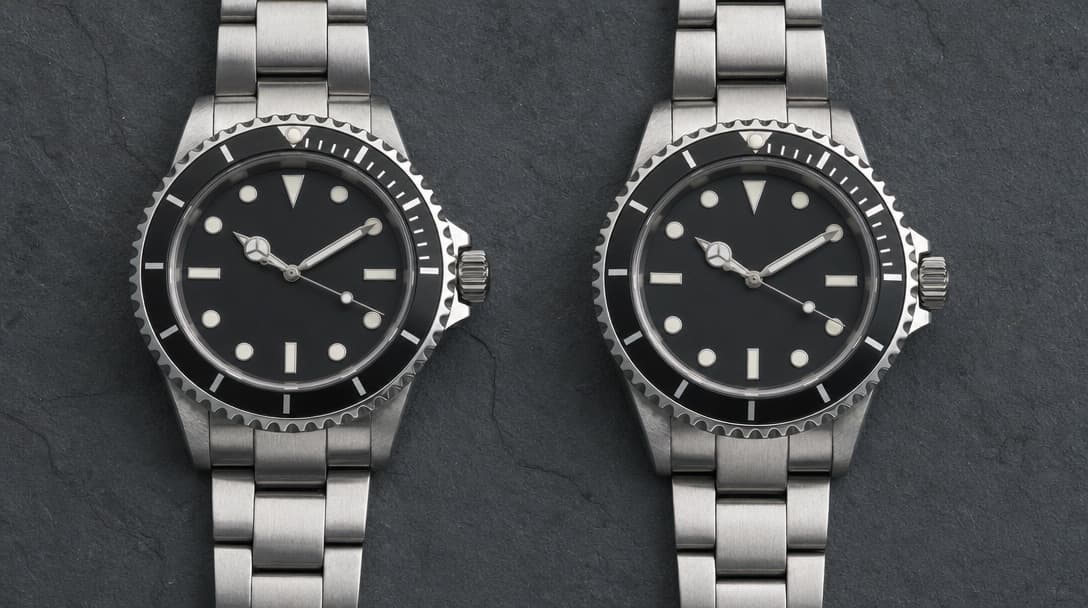

People treat this as a quality question, or a price question, or a politeness question. It is none of those. It is a trademark question, and once you see that, every other difference falls into place.
A homage borrows a design. A replica borrows a design and the brand markings. That single distinction decides what is legal to sell, what customs seizes, what you can resell, and what happens if the watch needs service.
Side-by-side comparison
| Replica | Homage | |
|---|---|---|
| Definition | An unauthorised copy of a trademarked watch | A watch inspired by a famous design, without trademarked elements |
| Brand name on dial | Yes, copied | No, its own brand |
| Logo or crown | Yes, copied | No |
| Model name | Yes, copied | No |
| Design language | Copied closely | Borrowed, often adjusted |
| Legal to sell commercially | Generally no | Yes, on most marketplaces |
| Legal to own and wear | Generally not prosecuted for personal use | Fully legal |
| Customs seizure risk | Real, shipments are seized at port of entry | None, it is not counterfeit |
| Manufacturer warranty | No, dealer warranty only | Yes, from the brand |
| Resale | Restricted, most marketplaces prohibit it | Open |
| Quality range | Entry tier to super clone | Entry tier to genuinely excellent |
| Also called | Clone, super clone, 1:1 | Tribute |
What makes something a homage
A homage takes the visual idea and leaves the trademarks behind.
It carries its own brand name on the dial. It does not reproduce the original maker's logo, crown, shield, or model name. It may use a similar case shape, a similar bezel, a similar dial layout, and a similar bracelet, because design language on its own is not what trademark law protects in this context.
The result is a watch that reads as familiar from across a room and identifies itself honestly from arm's length. Plenty of established microbrands build their entire catalogue this way, and they sell openly on Etsy, eBay, and mainstream retail channels because there is nothing to hide.
"Tribute" means the same thing. The two words are interchangeable.
What makes something a replica
A replica reproduces the trademarked brand markings. The name on the dial, the logo, the model designation, the engraving on the case-back and the rehaut.
That is the entire difference. It is not about how good the watch is, how much it costs, or what tier the seller assigns it. A super clone with a cloned Swiss movement and a 904L case is a replica. A cheap watch with a copied logo is also a replica. Both cross the same line for the same reason.
The legal difference, stated carefully
This section summarises our legal guide, which covers the topic in full.
Homages are straightforwardly legal. They carry no trademarked markings, so there is nothing for a trademark holder to act on. They ship, sell, and resell normally.
Replicas are a split picture. In the US, Canada, and the EU, personal-use possession is generally not criminally prosecuted. Wearing one is not illegal. Commercial trafficking is illegal everywhere: in the US under 18 U.S.C. § 2320, and in the EU under the customs framework of Council Regulation (EU) No 608/2013.
Customs is where the practical difference lands. US Customs and Border Protection, the Canadian Border Services Agency, and EU customs authorities all seize counterfeit shipments at port of entry. Rough estimates put US seizure at 5 to 15 percent of replica shipments and Canada lower, perhaps 3 to 8 percent. A homage passes customs like any other watch, because it is not counterfeit.
Selling a replica as authentic is fraud, regardless of marketplace and regardless of jurisdiction. That is a separate offence from the trademark question and it applies even between private individuals.
Quality is a separate axis
The most common mistake is assuming homage means cheap and replica means good, or the reverse. Neither holds.
Homages span the full range. Some are inexpensive and unremarkable. Others use Swiss or high-grade Japanese movements, sapphire crystals, and finishing that competes with watches costing several times more, and they come with a real manufacturer warranty and a service path.
Replicas span the full range too, from entry-tier watches with Asian base movements to super clones with cloned Swiss calibres, 904L steel, and dial accuracy approaching genuine. Our super clone against AAA comparison covers how to tell those tiers apart.
So the honest framing is two independent questions. First: does it carry someone else's trademarks? That decides the legal category. Second: how well is it made? That decides whether it is a good watch.
What each one actually costs you
| Consideration | Replica | Homage |
|---|---|---|
| Buying it | Dealer channels, crypto and card | Any normal retailer |
| Shipping it | Seizure risk at customs | Normal |
| Warranty | Dealer warranty, typically 60 to 90 days | Manufacturer warranty |
| Servicing | Independent watchmakers only | Brand or independent |
| Reselling it | Most marketplaces prohibit the listing | Open, normal resale |
| Wearing it | Legal, and it reads as the original | Legal, and it reads as itself |
| Telling people | You decide | Nothing to decide |
Which one should you buy
- You want the exact look of a specific reference, accepting the trade-offs? A replica, bought from a vetted dealer, with quality-control photographs before it ships.
- You want the design language without the legal category? A homage. There are excellent ones.
- You want a manufacturer warranty and a normal service path? A homage.
- You plan to resell it later? A homage. Replica resale is restricted almost everywhere.
- You are shipping internationally and cannot risk a seizure? A homage.
- You want to give it as a gift without explaining anything? A homage.
The one rule that applies to both
Never represent either one as genuine.
Wearing a replica is legal. Selling it as authentic is fraud, and that is true whether you are a dealer or a private seller passing on a watch. It is the one line in this whole subject that carries no ambiguity in any jurisdiction.