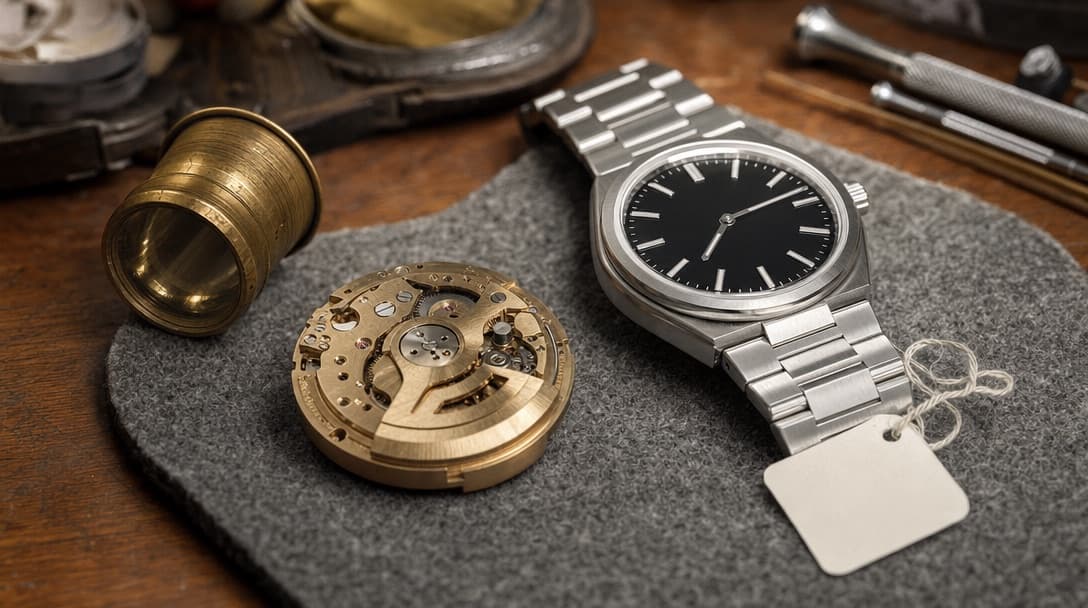
Buyers ask which is better as though these are two rungs on the same ladder. They are not. They are two different kinds of word.
"Super clone" describes checkable hardware: a cloned Swiss movement instead of an Asian base, a 904L steel case, dial accuracy that approaches the genuine article. You can verify every part of that claim. "AAA" is a marketing tier label that sellers apply to their own products. It has no standardised meaning anywhere in the niche, and nobody audits it.
So the honest comparison is not "which grade is higher". It is "which of these two words tells you anything at all".
Side-by-side comparison
| Super Clone | AAA Replica | |
|---|---|---|
| Type of term | Specification | Marketing label |
| Who assigns it | Community and factory spec sheets | The seller |
| Standardised? | Broadly yes, in practice | No, none |
| Verifiable? | Yes, on three concrete points | No |
| Movement implied | Cloned Swiss calibre | Nothing specific |
| Case material implied | 904L steel | Nothing specific |
| Dial accuracy implied | Approaching genuine | Nothing specific |
| Typical price | Roughly $400 to $1,700 | Any price at all |
| Useful when shopping? | Yes | No |
| What to do with it | Verify the three criteria | Disregard it |
What "super clone" actually means
The term carries three specific claims, and each one is checkable before you buy.
1. A cloned Swiss movement, not an Asian base. This is the load-bearing criterion. A super clone runs a calibre engineered to reproduce the genuine movement's architecture, layout and finishing, so that it reads correctly through a display case-back and matches the genuine beat rate. A watch running a Seiko NH35 base is a good watch and it is not a super clone. Our movements guide covers what a cloned calibre reproduces and what it does not.
2. A 904L steel case. Rolex uses 904L. The leading factories use 904L. It is denser than 316L, takes a slightly different polish, and resists corrosion better. Not every super-clone factory uses it on every model, so treat this as a strong signal rather than an absolute rule.
3. Dial accuracy approaching genuine. Printing that stays sharp under a loupe, applied markers seated flush and level, correct font weights and spacing. This is the criterion that separates the top factories from each other, and it is the one you can judge yourself from quality-control photographs.
Meet all three and the label is earned. Meet one and it is not.
What "AAA" actually means
Nothing standardised. It is a tier label that sellers use to imply premium quality, and there is no body that defines it, no criteria that must be met, and no consistency between one seller and the next.
Two problems follow.
It is self-assigned. The person applying the grade is the person selling the watch. A seller has no incentive to grade their own inventory down, so in practice everything a shop lists ends up at or near the top of the shop's own scale.
Labels like this inflate. Once every listing is AAA, the only way to signal "better than that" is another letter or another plus sign. The scale has no ceiling because it has no definition, which is exactly why comparing an AAA listing on one site to an AAA listing on another tells you nothing.
Where "1:1" fits
Same category as AAA, slightly different wording. "1:1" claims a one-to-one match with the genuine article, and in practice no replica is literally that.
What it usually signals is that the seller believes the watch belongs in the super-clone tier. That is a useful hint about intent and a useless proof of anything. Treat it exactly as you treat AAA: as a pointer toward the questions that matter, not as an answer to them.
The three questions that replace the label
| Instead of asking | Ask this | Why it works |
|---|---|---|
| Is it AAA? | Which calibre is inside? | Names a specific movement you can look up |
| Is it 1:1? | 904L or 316L? | A material claim, not an adjective |
| Is it super clone grade? | Which factory built it? | Ties the watch to a known production record |
| Is it high quality? | Can I see QC photos of my actual watch? | Moves from claim to evidence |
A seller who answers all four clearly is worth buying from. A seller who answers in adjectives is selling adjectives.
What the price band tells you
Super-clone pricing runs roughly $400 to $1,700 depending on the reference and the factory. The table below lists the major factories rather than the tier alone, because one of them sits on the boundary instead of inside it.
| Factory | Typical price | What that buys |
|---|---|---|
| Noob Factory | $900 to $1,300 | Seiko NH35 base, 316L steel, legacy Rolex references |
| AR Factory | $1,000 to $1,400 | Cloned 3135, 904L steel, 40mm Submariner focus |
| VSF Factory | $1,200 to $1,600 | Cloned Omega Co-Axial, cloned 4130 Daytona |
| Clean Factory | $1,300 to $1,700 | Cloned VR3135, VR3186, VR4130, 904L steel |
Noob is the instructive row. It is priced alongside the super-clone factories and it runs a Seiko base in 316L steel, which is why we rate it mid to super clone rather than super clone. Price alone does not place a watch in the tier. The calibre and the steel do.
Notice what the ladder is actually built from: movements and materials, not letters. That is the whole argument of this page in one table.
A listing far below these bands is not a bargain in the tier. It is a different tier wearing the tier's vocabulary.
How to use this when you shop
- Delete the grade from the listing in your head. AAA, AAA+, 1:1, premium: none of it constrains what arrives.
- Ask for the calibre by name. Then look it up. A cloned 3135 and an NH35 are not the same purchase.
- Ask for the case material. 904L or 316L. It is a one-word answer, and hesitation is informative.
- Ask which factory built it. Then read that factory's record.
- Ask for quality-control photographs of your actual watch. Not stock images, not a similar unit.
- Inspect the photographs properly. Our spotting quality guide covers what to look at and in what order.
Steps two through four cost you one message. They eliminate more bad purchases than every grading letter ever printed.