Most people asking this question are not collectors. They inherited a watch, bought one secondhand, or were given one as a gift, and something about it feels uncertain. The good news is that you can get to a confident answer on the large majority of watches without opening the case, without special tools beyond a magnifier, and without paying anyone.
This guide runs through twelve checks in the order that catches the most fakes fastest. Work down the list and stop when something fails, because a single clear failure is usually enough.
1. Weight
This is the first thing to check because it is the hardest thing to fake cheaply. Rolex cases and bracelets are cut from a dense steel alloy the company calls Oystersteel, and a finished steel sports model feels substantially heavier than its size suggests. Counterfeits are usually made from lighter, cheaper steel, and many use hollow bracelet links to save cost.
You do not need a scale. Hold the watch in your palm and then hold any ordinary steel watch in the other hand. The difference on a genuine piece is obvious and slightly surprising the first time.
2. The seconds hand
A genuine modern Rolex runs at 28,800 vibrations per hour, which works out to eight beats per second. To the eye, the seconds hand appears to glide in a smooth sweep rather than jumping once per second.
Watch it for a full ten seconds under good light. If the hand ticks in single, distinct one-second jumps, the movement inside is a quartz unit and the watch is not a genuine modern Rolex. Note the nuance: a smooth sweep does not prove authenticity, because good counterfeits also use automatic movements. A one-second tick disproves it.
3. The cyclops magnification
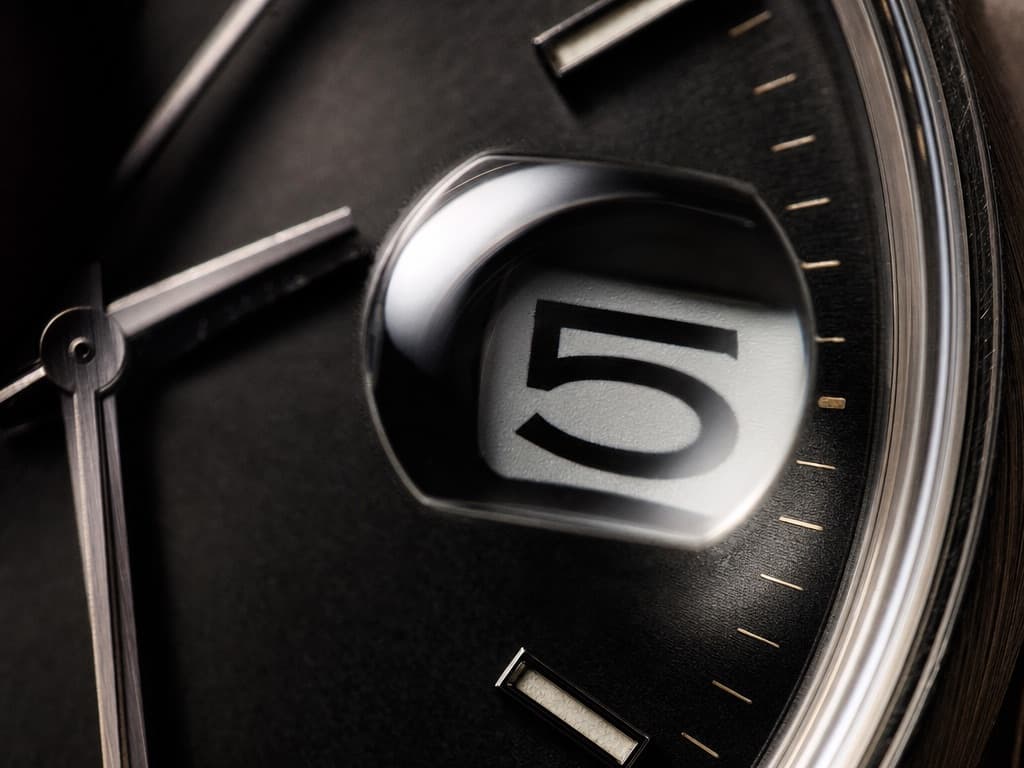
On any Rolex with a date, the small bubble in the crystal over the date window magnifies the date by roughly two and a half times. The date should fill the bubble almost completely and be easy to read at a glance.
Counterfeits very commonly get this wrong. The usual failures are magnification that is far too weak, so the date looks only slightly larger, or a bubble that is not centred over the window. Look at it straight on, not at an angle.
4. The crown etched into the crystal
From roughly 2002 onward, Rolex has laser-etched a tiny crown logo into the sapphire crystal at the six o'clock position. It is deliberately hard to see. You need to tilt the watch under a direct light source and look at the right angle before it appears.
The mark should be extremely fine and appear to sit inside the glass rather than on top of it. On fakes it is often too large, too obvious, visibly printed on the surface, or missing entirely. On a watch made before about 2002 its absence means nothing.
5. The rehaut engraving
The rehaut is the slim inner ring between the dial and the crystal. From roughly 2005 onward, Rolex engraves the word ROLEX repeatedly around this ring, with the watch's serial number at the six o'clock position.
Two things to check. The engraving should be crisp and perfectly aligned with the markers, and the serial engraved here should match the serial found elsewhere on the watch. Misaligned or shallow rehaut text is one of the most reliable counterfeit tells on modern references.
6. Serial and model numbers
Older watches carry the serial number between the lugs at six o'clock and the model reference between the lugs at twelve, both hidden under the bracelet. Newer watches carry the serial on the rehaut as described above.
Whichever position applies, the numbers should be finely and evenly engraved, not stamped shallowly or acid-etched with a sandy texture. Numbers that feel rough to a fingernail, or that are uneven in depth across the string, point to a counterfeit.
7. Dial printing and applied markers
Under a magnifier, printed dial text on a genuine watch is razor sharp with clean edges and consistent spacing. Hour markers are applied metal parts, seated cleanly and level, not printed onto the dial surface.
Look specifically at the smallest text on the dial. Counterfeits frequently produce text that looks slightly furred or bleeds at the edges under magnification, because the printing process cannot hold the same resolution.
8. The caseback
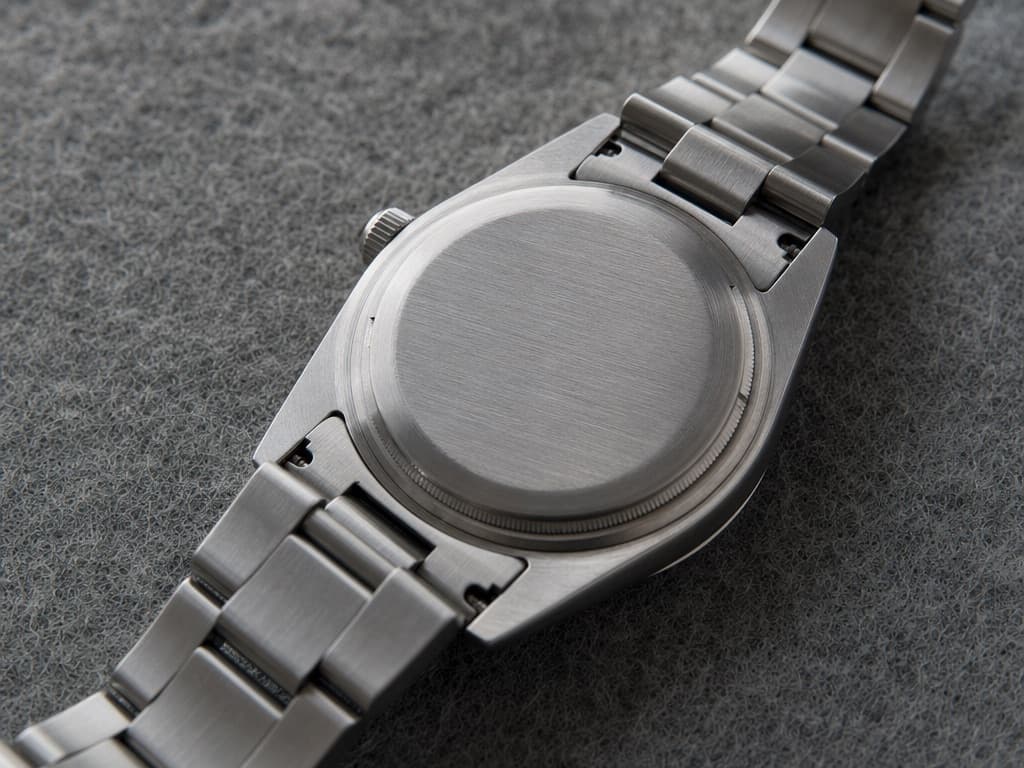
This check eliminates a large number of fakes immediately. The vast majority of Rolex watches have a plain, smooth steel caseback with no display window and no decoration.
If your watch has a clear caseback showing the movement, or an engraved logo, model name, or crown on the back, it is almost certainly not genuine. There are narrow historical exceptions, so treat this as a strong signal rather than absolute proof, but for a modern watch it is close to conclusive.
9. The crown and winding feel
Unscrew the crown and wind the watch. On a genuine piece the crown unscrews smoothly, the winding has an even and slightly firm resistance, and the whole action feels solid.
Counterfeits often feel gritty, loose, or unusually easy to turn. The crown itself should also be finished to the same standard as the case, with a cleanly formed logo rather than a soft, rounded approximation.
10. The bracelet and clasp
Genuine bracelets use solid links throughout. Press the bracelet and flex it gently. It should feel dense with no rattle, and the links should have almost no side-to-side play.
The clasp should close with a firm, positive click and sit flush when closed. Hollow-feeling links, visible gaps at the joints, or a clasp that closes loosely all point away from authenticity.
11. The lume
Apply a strong light to the dial for thirty seconds, then move to a dark room. Modern Rolex lume glows blue and stays bright for a long time. Older watches use a green-glowing compound.
The glow should be even across every marker and both hands, with no patches and no markers noticeably dimmer than others. Weak, uneven, or rapidly fading lume is a common shortcut on counterfeits.
12. Paperwork, seller and price
The final check is the context around the watch rather than the watch itself.
- Price. A genuine steel sports Rolex does not sell for a few hundred dollars. If the price is far below the market rate for that reference, that is the answer.
- Papers. Card, booklet and box add confidence, but they are also faked, so treat them as supporting evidence rather than proof.
- Seller. A seller who cannot say where the watch came from, refuses close photographs, or pushes for an irreversible payment method is telling you something.
Summary table
| Check | Genuine | Common counterfeit failure |
|---|---|---|
| Weight | Dense, heavier than expected | Noticeably light |
| Seconds hand | Smooth sweep, 8 beats per second | Single one-second ticks |
| Cyclops | Date magnified about 2.5x | Weak or off-centre magnification |
| Crystal crown | Tiny etch at 6 o'clock, hard to see | Too obvious, printed, or absent |
| Rehaut | Crisp ROLEX text, serial at 6 | Misaligned or shallow |
| Serial | Finely engraved, consistent | Rough, shallow, sandy texture |
| Dial text | Sharp under magnification | Furred or bleeding edges |
| Caseback | Plain steel, no window | Display back or engraving |
| Crown | Smooth, firm winding | Gritty or loose |
| Bracelet | Solid links, no rattle | Hollow, loose, gaps |
| Lume | Even, long-lasting glow | Patchy, fades fast |
| Price | At market rate | Far too cheap |
What these checks cannot tell you
Two limits are worth being honest about.
The first is that these checks catch the vast majority of counterfeits but not the very best ones. High-grade reproductions built around cloned movements can pass most external inspection. Distinguishing those reliably requires opening the case and examining the movement, which is a job for a watchmaker.
The second is that a genuine case can contain replaced parts. A watch can be authentic and still carry an aftermarket dial, bezel or bracelet, which affects value considerably even though the watch is not a fake.