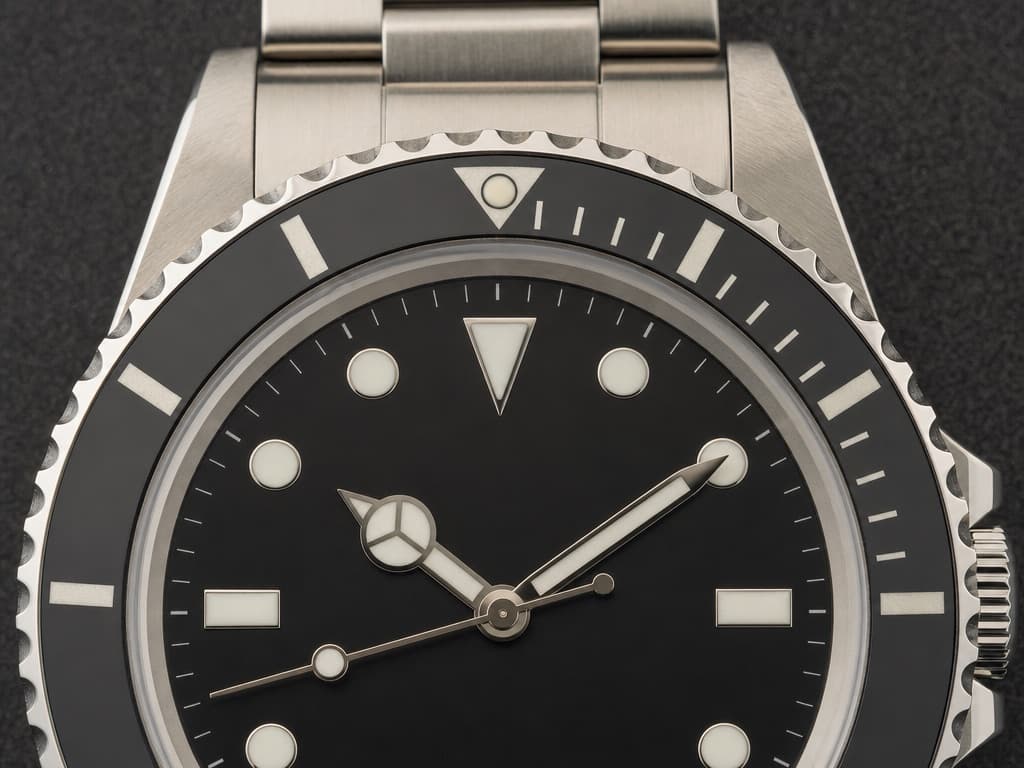

The Submariner is the most counterfeited watch in the world, which cuts both ways. It means you are more likely to encounter a fake, and it also means the failure points are extremely well documented.
This guide covers the checks that are specific to the Submariner rather than generic to Rolex. The bezel in particular does most of the work here, because it is the single hardest part of this watch to reproduce properly.
Comparison at a glance
| What to check | Real | Fake |
|---|---|---|
| Bezel direction | Anticlockwise only | Often rotates both ways |
| Bezel clicks | 120, firm and evenly spaced | Fewer, mushy, or uneven |
| Bezel alignment | Triangle dead centre at 12 | Visibly off, or drifts |
| Bezel play | None vertically | Lifts or wobbles |
| Date magnification | About 2.5x, fills the bubble | Weak, date looks small |
| Lume | Even, blue on modern watches | Patchy, fades quickly |
| Caseback | Plain solid steel | Display window or engraving |
| Crown guards | Crisp, symmetrical | Soft, uneven shaping |
| Bracelet | Solid links, no rattle | Hollow, audible rattle |
| Case proportions | Compact, thick, dense | Often too thin or too large |
The bezel does most of the work
It must turn one way only
A Submariner bezel is unidirectional. It rotates anticlockwise and stops dead if you try to turn it clockwise. This is a dive-watch safety feature: the bezel can only ever shorten your estimated remaining time, never extend it.
Many counterfeits use a bidirectional bezel because it is simpler to manufacture. If the bezel turns freely in both directions, you are finished.
Count the clicks
A modern Submariner bezel has 120 clicks, so each click represents half a minute. Turn it slowly through a full rotation and count.
The clicks should be firm, evenly spaced, and precise. Counterfeits commonly use 60 clicks, or produce a soft, mushy action with inconsistent spacing.
Check the alignment
Look straight down at the watch, not at an angle. The triangle marker on the bezel should sit exactly at twelve o'clock, perfectly aligned with the dial below.
Rotate it a full turn and check that it returns to true alignment. Bezel misalignment is one of the most common giveaways on otherwise decent counterfeits, because it requires tolerances that cheap production does not hold.
Press down on it
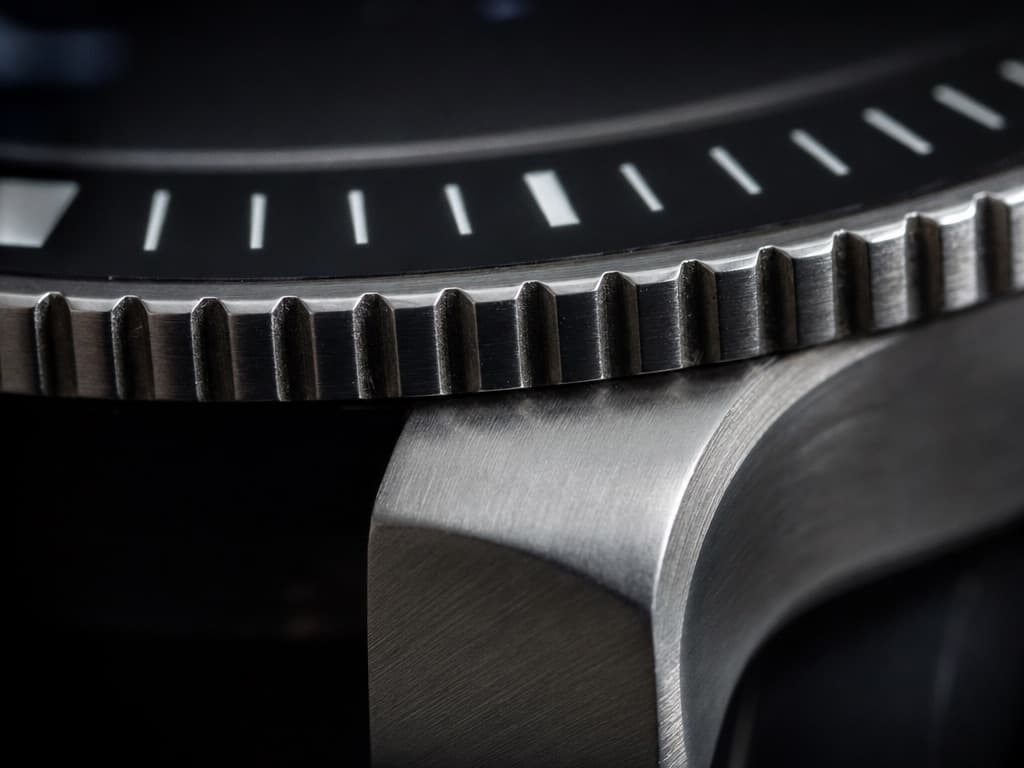
The bezel should not lift, wobble, or shift vertically. Any play between the bezel and the case indicates poor construction.
Dial, crystal and lume
Date magnification
On date models the cyclops magnifies the date by roughly two and a half times, and the numerals should nearly fill the bubble. Weak magnification that leaves obvious empty space is a frequent counterfeit failure.
Note that the No-Date Submariner has no date window and no cyclops at all. A "Submariner" with a cyclops but no date, or a date with no cyclops, is wrong on its face.
Lume behaviour
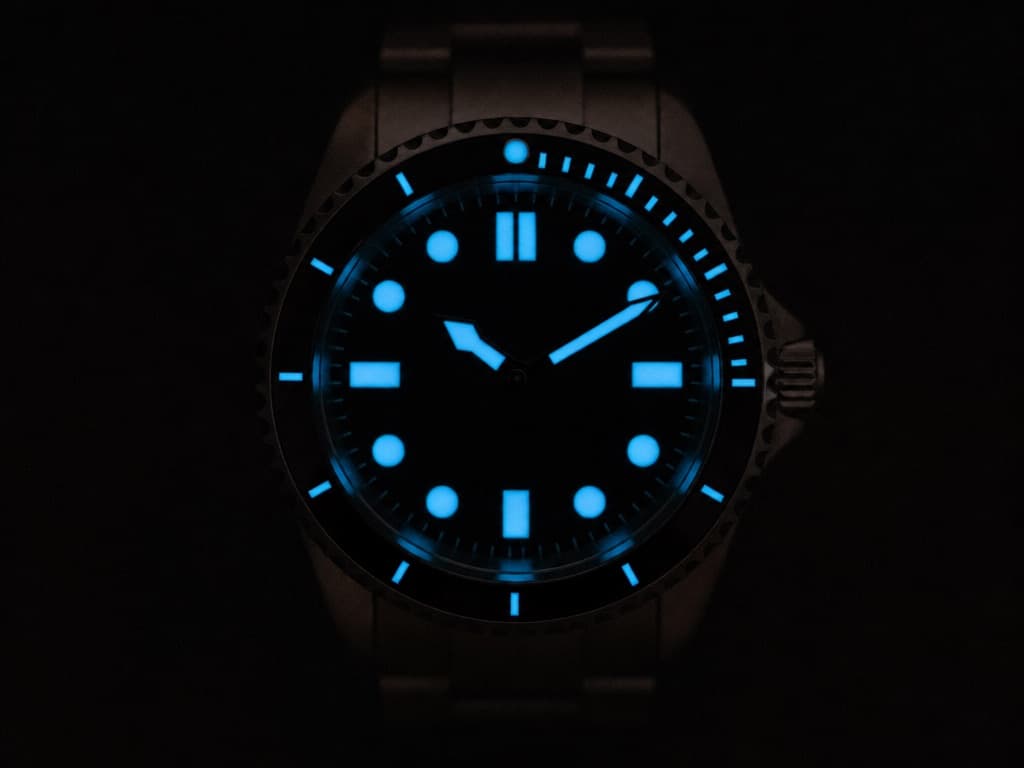
Charge the dial under a strong light for thirty seconds, then move into darkness. Modern Submariner lume glows blue and holds brightness for hours. Older watches glow green.
Every marker and both hands should glow at identical intensity. Look especially at the triangle at twelve and the pip on the bezel. Uneven glow, dim markers, or a glow that dies within minutes all indicate a counterfeit.
Dial printing
Under a loupe, printed text should be sharp with clean edges. The applied markers should sit flush and level, catching light identically as you tilt the watch.
Case, crown and caseback
Crown guards
The crown guards flanking the winding crown should be crisply shaped and symmetrical, flowing cleanly into the case profile. Counterfeits often produce guards that look soft, slightly melted, or subtly asymmetric.
The crown itself
Unscrew and wind. The action should be smooth with even, slightly firm resistance. Gritty, loose, or unusually easy winding points away from authenticity.
Caseback
A Submariner caseback is plain, smooth steel. No display window showing the movement, no engraved logos, no model name.
A clear caseback effectively settles the question. This is the fastest single check on the entire watch.
Case proportions
Genuine Submariners are compact and dense, and thicker than photographs suggest. Counterfeits frequently get the proportions subtly wrong, most often by making the case too thin, since a slimmer case is easier to build around a generic movement.
Bracelet and clasp
Genuine bracelets use solid links throughout. Hold the case and let the bracelet hang, then shake gently. It should feel dense and quiet, with minimal side-to-side play between links.
Hollow links rattle audibly and feel light. The clasp should close with a firm, positive click and sit completely flush, with no gaps at the joint and no tendency to pop open under light pressure.
The order to run them in
- Rotate the bezel. Both directions? Done, it is fake.
- Count the clicks. Not 120? Almost certainly fake.
- Check bezel alignment straight down at twelve.
- Flip it over. Display caseback? Fake.
- Feel the weight. Light for its size is a bad sign.
- Check date magnification if it is a date model.
- Shake the bracelet and listen for rattle.
- Charge the lume and check for even glow.
The first four catch most counterfeits in under a minute.